Colorado Wildfire Smoke Damage: Is Your HVAC Spreading It?
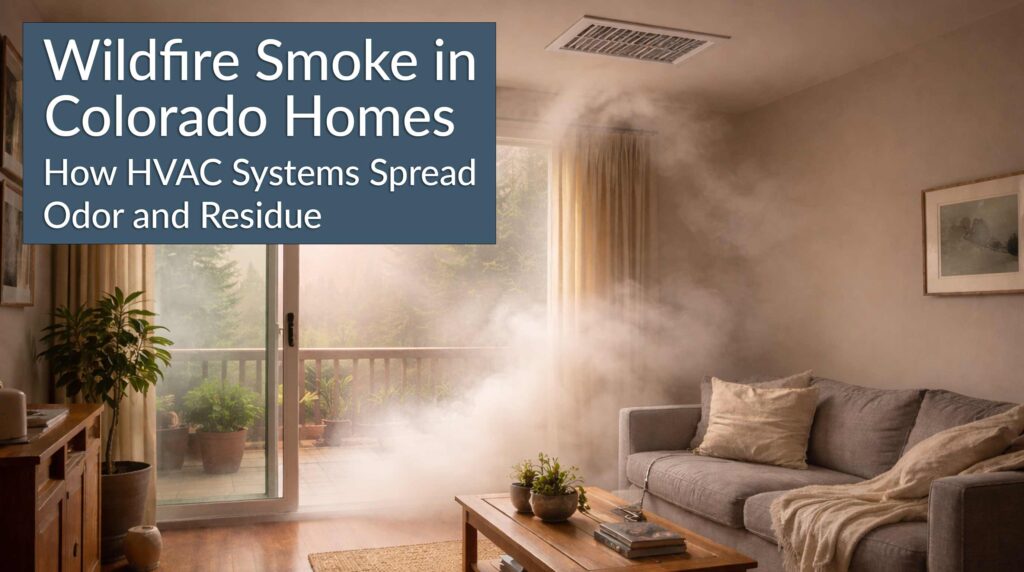
Wildfires are an unavoidable reality in our dry, high-altitude state. But you do not have to live next to the tree line to experience the aftermath. Fueled by Colorado’s high winds, microscopic smoke particulates travel for miles, creeping into homes and leaving a stubborn “campfire” odor behind. If the outdoor skies have cleared but your house still smells like smoke, the culprit is often your HVAC system—and in many cases, the solution involves a professional smoke-damage HVAC cleaning process.
How Smoke Breaches Homes and Spreads Through HVAC Ductwork
No Home Is Completely Airtight
It’s easy to assume that closing the windows keeps smoke outside, but even well-built homes naturally exchange air with the outdoors. Fine smoke particles can enter through small gaps around doors and windows, attic and roof vents, bathroom and kitchen exhaust fans, and other minor openings in the building envelope.
Homes are not completely airtight—and that’s actually a good thing. Fresh air ventilation helps maintain healthy indoor environments. However, during wildfire events, those same pathways can allow smoke particles and odors to enter the home and circulate through the indoor air.
The HVAC System Acts as a Vacuum
As your air conditioner or furnace runs, it continuously pulls indoor air into its return vents. If that air is laced with wildfire smoke, your system unknowingly drags those sticky, microscopic particles deep into your ductwork. Long after the fire is contained, that leftover residue circulates the persistent smoke smell throughout your house every time the blower fan turns on.
Why This Requires More Than a Filter Change
If you are a homeowner, property manager, or restoration contractor dealing with the aftermath of a smoke event, replacing the air filter alone will not resolve contamination inside the HVAC system. Smoke—particularly from wildfires—contains extremely fine particulate matter that can travel deep into ductwork, trunk lines, and mechanical components.
Even high-quality residential air filters capture only a portion of these particles. The smallest smoke particulates easily pass through most residential filtration systems and continue circulating through the HVAC system. Once this occurs, the system itself can become a reservoir for smoke contaminants, repeatedly redistributing odor each time the system operates. In these situations, the issue often calls for professional residential air duct cleaning along with a careful evaluation of smoke impact.
Spotting the Signs of HVAC Smoke Damage
Look for Dark Rings at Return Vents
One of the earliest signs of smoke intrusion is a dark, grayish film gathering around your return air grilles. Because these vents constantly pull air in, they usually show soot buildup before other parts of the house. While a dirty vent doesn’t automatically mean your whole system is ruined, it’s a major red flag that smoke has entered your ductwork.
Odor Spikes When the System Runs
Does the smoke smell suddenly get worse when the heat or AC kicks on? That is a textbook sign. Air moving rapidly across soot-coated duct walls acts as a constant delivery system for smoke odors.
Red flags of HVAC smoke damage
- Dark soot or gray shadows around return vents
- Smoke smell is noticeably stronger when the HVAC runs
- Air filters turning black or clogging unusually fast
- Fine dark dust settling on furniture near supply vents
Where residue hides best
- Return ductwork (pulls the dirty air)
- Main trunk lines
- Inside the furnace cabinet and blower motor
- Bends and directional changes in the ducting
In most cases, these signs do not mean the HVAC system needs replacement. They simply indicate that the system likely requires professional cleaning.
Buyer Beware: The Post-Fire Influx of Out-of-State Cleaners
Watch Out for “Storm Chasers”
When a major wildfire affects Colorado, it can attract out-of-state contractors looking to make quick money. Some may be legitimate, but others set up temporary operations, offer aggressively low duct cleaning prices, and disappear once the smoke clears—leaving homeowners with no warranty, no accountability, and no recourse.
Why Method Matters More Than Speed
Professional HVAC smoke remediation is a rigorous source-removal process. It necessitates specialized agitation tools, strategic access to the ventilation lines, and HEPA-filtered vacuum collection to ensure the total extraction of soot and residue.
Questions to Ask Before Hiring a Cleaner
After a wildfire or indoor smoke event, choosing the right contractor matters. Smoke residue can settle deep inside HVAC components and trunk lines, and improper cleaning methods can spread contamination further through the system. Before hiring any company, ask the following questions to confirm the work follows recognized industry standards and proper source-removal practices.
- Is your company NADCA certified? A qualified HVAC cleaning provider should follow the National Air Duct Cleaners Association (NADCA) ACR Standard. Verify membership through NADCA’s Find a Professional directory .
- Are you locally based and permanently operating in Colorado? Ask whether the company uses its own trained employees rather than temporary crews or subcontractors.
- How will you access and clean the deep trunk lines? Proper source removal requires direct access to the main supply and return trunk lines. Ask whether the company provides before-and-after photo documentation of the interior ductwork.
- Do you use a closed-loop, HEPA-filtered vacuum collection system? Proper HVAC cleaning requires a HEPA-filtered vacuum system while technicians perform mechanical agitation source removal inside the ductwork. Compressed air alone is not sufficient to remove adhered soot and debris.
- Are you removing the smoke contamination or simply masking odors? Be cautious of companies that rely on fragrances or deodorizing chemicals. If chemical products are proposed, ask to review the applicable Safety Data Sheet (SDS).
If you are stressed after an evacuation or a close call, do not let high-pressure sales tactics rush your decision. A reputable contractor should explain the cleaning process clearly, answer questions directly, and set realistic expectations.
Do You Really Need a Professional HVAC Inspection?
Not Every Fire Causes a Disaster
A single afternoon of hazy skies probably will not ruin your air conditioner. The severity of HVAC contamination depends on how long the smoke lasted, how close the fire was, and whether you were running your AC or furnace heavily while the air quality was poor.
When to Make the Call
An inspection makes sense if: the smoke smell stays trapped indoors for days after the sky clears, you see physical soot at your vents, you are burning through air filters incredibly fast, or the odor spikes specifically when the blower fan turns on.
The Bottom Line
Ask yourself this: Was my system running during the heaviest smoke, and can I still smell it or see it now? If the answer is yes, get it evaluated by a professional as part of your broader home cleanup plan.
Why Colorado’s Climate Makes Smoke Damage Worse
Dry Air Keeps Particles Airborne Longer
Colorado’s famous lack of humidity is great for avoiding mosquitoes, but terrible for wildfire smoke. In humid climates, moisture helps weigh down ash and clear the air. In our dry climate, fine smoke particles stay suspended and highly mobile for much longer, allowing them to easily infiltrate our homes and HVAC systems.
Heavy Summer AC Usage
Wildfire season often peaks during our hottest months. Because Coloradans are running their air conditioning for hours at a time to beat the heat, the HVAC system acts as a constant engine, circulating and packing smoke residue deeper into the mechanical components with every cycle.
Unique Home Layouts
From sprawling ranch homes with complex basement ductwork to multi-story mountain builds with complex vertical chases, Colorado homes have unique airflow dynamics. These varied designs create multiple paths for smoke to travel, making it crucial to have an expert evaluate your specific layout rather than applying a “one-size-fits-all” cleaning approach.
Why NADCA Certification Matters for Smoke Remediation
Smoke Removal Is Not Routine Dusting
When selecting a remediation partner, prioritize companies with a documented history of specialized fire and smoke restoration. Getting it out requires aggressive mechanical agitation and strict vacuum control, not just a quick brush-through.
The NADCA Standard
Partnering with a NADCA-certified contractor is essential for ensuring a verifiable source-removal process. These industry-standard protocols require a sophisticated understanding of system architecture and containment. For homeowners comparing options, it also helps to understand the difference between routine residential air duct cleaning and the more specialized scope involved in smoke-damage HVAC remediation.
